
Birmingham (Listeni /ˈbɜrmɪŋəm/ BUR-ming-əm, locally /ˈbɜːmɪŋɡəm/
BUR-ming-gəm[citation needed]) is a city and metropolitan borough in the
West Midlands county of England. It is the most populous British city
outside London, with a population of 1,028,701 (2009 estimate), and lies
at the heart of the West Midlands conurbation, the United Kingdom's
second most populous urban area with a population of 2,284,093 (2001
census). Birmingham's metropolitan area, which includes surrounding
towns to which it is closely tied through commuting, is also the United
Kingdom's second most populous with a population of 3,683,000.

A medium-sized market town
throughout the medieval period, Birmingham grew to international
prominence in the 18th century at the heart of the Midlands
Enlightenment and subsequent Industrial Revolution, which saw the town
at the forefront of worldwide developments in science, technology and
industrial organisation, producing a series of innovations that laid
many of the foundations of modern industrial society. By 1791 it was
being hailed as "the first manufacturing town in the world".
Birmingham's distinctive economic profile, with thousands of small
workshops practicing a wide variety of specialised and highly-skilled
trades, encouraged exceptional levels of creativity and innovation, and
provided a diverse and resilient economic base for an industrial
prosperity that was to last into the final quarter of the 20th century.
Its resulting high level of social mobility also fostered a culture of
broad-based political radicalism, that under leaders from Thomas Attwood
to Joseph Chamberlain was to give it a political influence unparalleled
in Britain outside London, and a pivotal role in the development of
British democracy.
Today Birmingham is a major international commercial centre, ranked as a
gamma− world city by the Globalization and World Cities Research
Network;[9] and an important transport, retail, events and conference
hub. With a city GDP of $90bn (2008 estimate, PPP), its urban economy is
the second largest in the UK and the 72nd largest in the world.
Birmingham's three universities and two university colleges make it the
largest centre of higher education in the United Kingdom outside
London,[11] and its major cultural institutions, including the City of
Birmingham Symphony Orchestra, the Birmingham Royal Ballet and the
Barber Institute of Fine Arts, enjoy international reputations.
People from Birmingham are known as 'Brummies', a term derived from the
city's nickname of 'Brum'. This may originate from the city's dialect
name, Brummagem, which may in turn have been derived from one of the
city's earlier names, 'Bromwicham'. There is a distinctive Brummie
dialect and accent, both of which differ from the adjacent Black
Country.
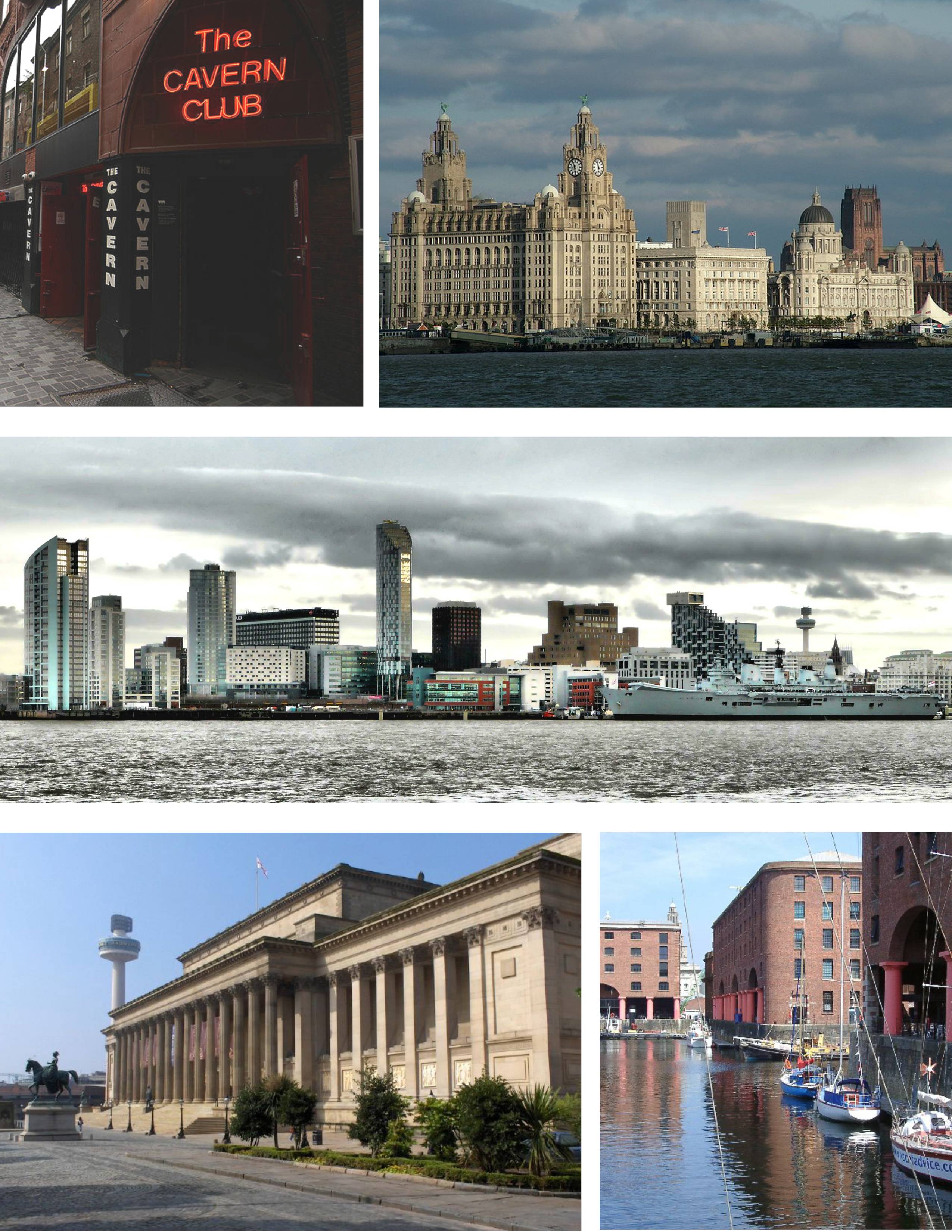 Liverpool, once home to the Beatles, was selected as the European Capital of Culture in 2008.

